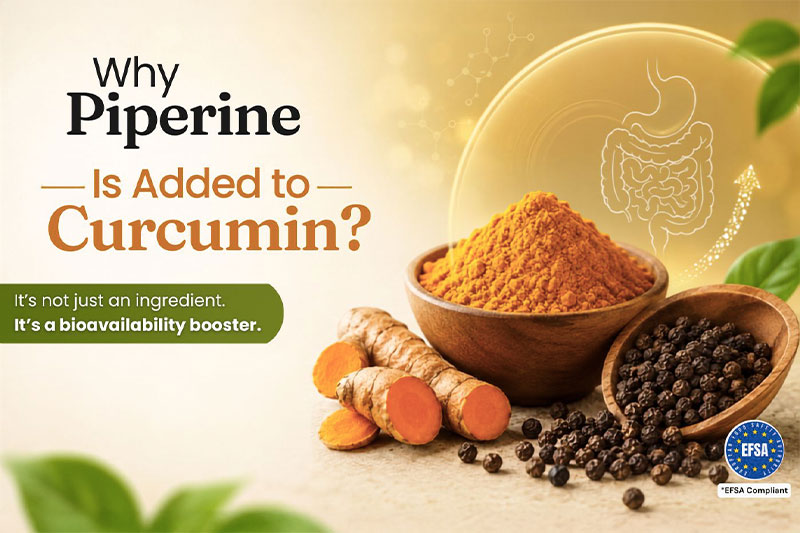
Curcumin is one of the most researched botanical actives on the market, credited with anti-inflammatory, antioxidant, joint, liver and cognitive benefits across hundreds of studies. It is also, on its own, a formulator's headache. Left unmodified, curcumin is poorly water-soluble, gets rapidly conjugated in the gut wall and liver, and clears the bloodstream almost as fast as it enters it. Oral bioavailability of unmodified curcumin is typically reported below one percent.
This is the problem black pepper was recruited to solve, long before anyone knew the word "glucuronidation." The active compound responsible is piperine, the alkaloid that gives pepper its bite. Once researchers began measuring it properly, starting with a landmark 1998 human and animal study that is still cited in nearly every "curcumin plus piperine" product on the market today, the traditional pairing turned out to have a real, mechanistic basis.
How Piperine Actually Works
Piperine is not a passive delivery aid. It is a pharmacologically active "bioenhancer" that interferes with the specific pathways that normally clear curcumin from the body before it can act. Three mechanisms do most of the work:
- UGT enzyme inhibition. Curcumin is rapidly glucuronidated and sulfated in the intestinal wall and liver, tagging it for excretion. Piperine inhibits these UGT enzymes, so a larger fraction of curcumin escapes conjugation on its first pass through the body.
- P-glycoprotein (P-gp) efflux inhibition. Even curcumin that is absorbed into intestinal cells is often pumped straight back into the gut lumen by the P-gp transporter. Piperine suppresses this pump, letting more curcumin stay on the absorption side of the gut wall.
- Increased local blood flow and membrane permeability. Piperine has a mild vasodilatory effect on intestinal tissue and appears to enhance passive membrane transport, giving absorbed curcumin a faster route into the bloodstream.
Together, these effects translate into a real, measurable jump in exposure. The original human pharmacokinetic study found that just 20 mg of piperine alongside 2 g of curcumin raised serum curcumin levels by roughly 2,000 percent compared with curcumin taken alone, and later studies have consistently shown multi-fold increases, even where the exact size of the effect varies with dose and study design. Formulators don't need much piperine to get there: black pepper extract is typically added at a small fraction of the curcumin dose, commonly around a 1:100 ratio, for example 5 to 20 mg of piperine alongside 500 to 2,000 mg of curcuminoids.
Piperine doesn't make curcumin more soluble, it slows down how quickly the body clears it, keeping more of it in circulation long enough to act.
Pepper Isn't Just a Delivery Vehicle
It's worth pausing on piperine itself, because its role in this pairing is often reduced to "the enhancer," when it has its own independent body of research behind it. Piperine is a recognised antioxidant, scavenging free radicals in its own right rather than only assisting curcumin's. It stimulates digestive enzyme activity and gastric acid secretion, which is part of why pepper has a centuries-old reputation as a digestive aid in Ayurvedic and Unani medicine, quite apart from anything it does for curcumin. Piperine also has a mild thermogenic effect, nudging metabolic rate upward, and animal studies have linked it to anti-inflammatory and respiratory benefits, including easing bronchial symptoms.
None of this is why pepper ends up in a curcumin formulation. But it does mean the ingredient is carrying more than one job description, which matters when a brand is deciding how prominently to feature it on pack.
A Pairing Worth Getting Right
Turmeric and black pepper is not folklore; it is a functional, well-characterized pharmacological pairing, and that combination of clear biology and hard evidence is exactly what makes it useful to formulators.
Because piperine works at such a low inclusion level relative to curcumin, it adds a meaningful bioavailability claim without materially changing capsule size, cost, or formulation complexity. It also means a product can be built around a lower curcumin dose for the same effective exposure, which helps with cost, capsule count, and patient compliance, while still standing on a mechanism specific enough to support a clear, defensible label claim. Few pairings in the botanicals category offer that combination of a large measured effect, a small added ingredient footprint, and this much published pharmacokinetic backing, which is why curcumin and piperine remain one of the most reached-for combinations in the industry more than two decades after the original studies.