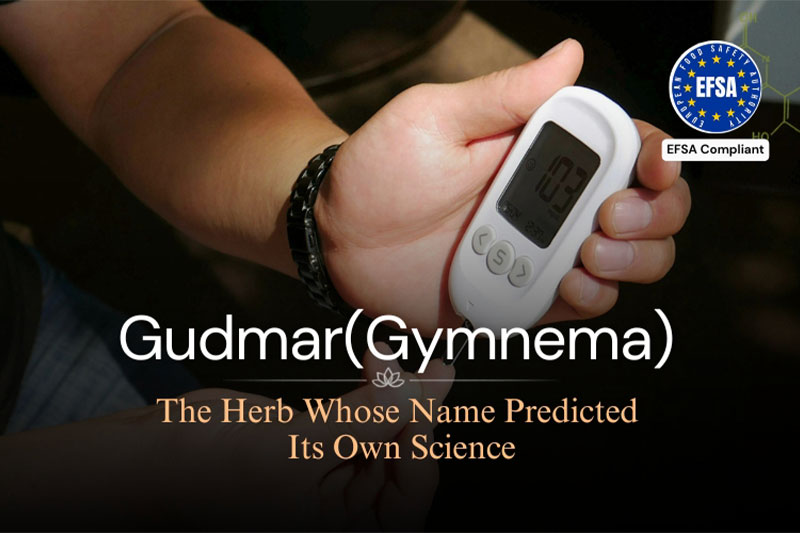
Break it down and the message is unmistakable: ‘gud’, meaning sugar or raw jaggery, and ‘mar’, to destroy or slay. The name translates to "sugar destroyer," earned for the plant's ability to abolish the sweet taste of food on contact. It is not a poetic flourish. It is a functional description, written into the plant's name over two millennia ago.
A second name, a second clue. The botanical genus carries its own etymology, this time from Greek: gymnos ("naked") and nema ("thread"), a reference to the bare, thread-like filaments of the plant's seed. Where the Hindi name describes function, the Latin name describes form. Together, the two names frame the herb from both sides: what it looks like botanically and what it does biologically.
What Ayurveda saw first.
Classical texts describe Gymnema as a remedy for ‘madhumeha’, literally "honey urine," the ancient descriptive term for diabetes, long before glucose in urine was a measurable clinical marker. Traditional accounts note that chewing the leaf left the tongue unable to register sweetness for hours, a sensory effect that turned out to be the first clue to how the plant actually works.
A proposed mechanism.
Gymnema's activity is attributed to a family of triterpenoid saponins called gymnemic acids, along with a smaller peptide, gurmarin. Their molecular shape is close enough to glucose that they are thought to act as a kind of decoy, working at two points in the body's contact with sugar:
- On the tongue. Gymnemic acid molecules are proposed to occupy the sweet-taste receptor sites (T1R2/T1R3) on the tongue's taste buds, temporarily blocking the receptor's ability to bind sugar molecules and register sweetness, without affecting other tastes.
- In the gut. At the intestinal brush border, the same molecular mimicry is thought to let gymnemic acids compete with dietary sugar for uptake sites, slowing the pace at which glucose crosses into the bloodstream after a meal.
Some research also points to a possible third effect, on pancreatic beta cells, where certain gymnemic acid fractions are proposed to support insulin-secreting cell function and regeneration, though this pathway is less established than the taste- and absorption-blocking effects above.1
Taken together, the proposed mechanism is elegantly literal: gudmar may not lower sugar through some indirect metabolic pathway, but by intercepting sugar at the two most direct points of contact, the tongue and the gut wall. It is molecular mimicry standing in for the plant's own name.
As metabolic wellness becomes one of the fastest-growing categories in EU nutraceuticals, ingredient buyers are looking for botanicals with both cultural depth and a coherent, explainable mode of action. Gymnema offers a rare combination: a name that has functioned as an accurate hypothesis for two thousand years, and a plausible mechanism that finally explains why. For formulators building blood-sugar-support supplements, functional beverages, or metabolic health stacks, it is a mechanism that tells its own story, provided it's presented with the precision the name demands.
To explore Gymnema sylvestre extract sourcing and specifications, visit www.phytoextractskp.com