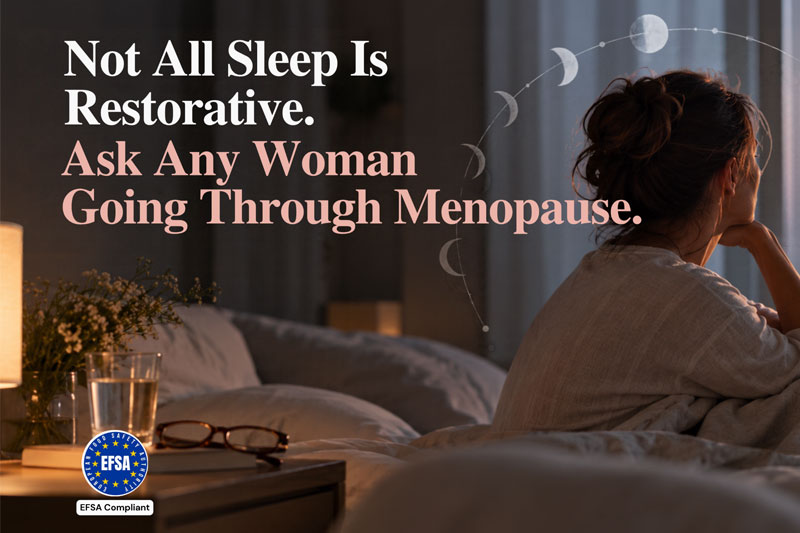
For many of these women, the nights look fine on paper. They go to bed on time, they stay there for seven or eight hours, and they still wake up feeling as if they never really slept. The problem isn't how long they sleep. It's what happens inside those hours.
The problem hiding inside "a full night"
Restorative sleep depends on architecture, not duration. The body needs to move cleanly through its cycles and spend real time in deep, slow-wave sleep, the stage where physical repair happens. Interrupt that with brief awakenings too short to remember, and someone can log eight hours and still wake up depleted.
Menopause is close to a perfect storm for exactly this kind of disruption. Falling oestrogen unsettles temperature control, so night sweats pull the sleeper up and out of deep sleep. Declining progesterone takes away some of its natural calming effect. Finnish sleep-laboratory research on peri- and postmenopausal women found their sleep is easily disturbed, turning shorter and more fragmented, with less deep and REM sleep.
Then cortisol joins in. In a laboratory model of menopause, fragmenting women's sleep raised their bedtime cortisol by 27%. Broken sleep lifts the stress hormone, and a raised stress hormone makes the next night harder. It's a loop, and many women recognise it long before anyone names it.
A bigger opportunity than hot flushes suggest
The scale is hard to ignore. A study of nearly 50,000 women, published in Menopause this year, found that around half of peri- and postmenopausal women in Europe report disturbed sleep, and that includes a large group with no hot flushes at all.
That matters for formulators. Many menopause products are built around cooling the hot flush, on the assumption that better sleep will follow. For a large group of women, it doesn't. The same research notes there are currently no medicines specifically indicated for menopause-related sleep disturbance, which leaves a clear space for well-substantiated nutritional support.
What a better formulation looks like
If non-restorative sleep has several causes, a single-target answer rarely holds up. A stronger brief asks three questions. Does the formula support falling asleep? Does it support staying asleep through the early hours? And does it address the stress side of the loop, not just the night itself?
That last question is where adaptogens come into play. Holy basil, or tulsi, has centuries of use in Ayurvedic tradition for calm and balance, and it is now building a modern evidence base. In a randomised, placebo-controlled trial of our standardised tulsi extract, Ocitum™, adults taking 300 mg a day for eight weeks saw a 35% reduction in serum cortisol and a 52% improvement in sleep latency. The trial wasn't run in menopausal women specifically, but it speaks directly to the cortisol and sleep loop this life stage is defined by. It is non-habit-forming, which matters for something taken night after night, for months or years.
For brands building in women's health, the opportunity isn't simply another sleep product. It's one that recognises sleep can be long and still broken, and that menopause is where that truth shows up most clearly.
If you're formulating for menopause or sleep support, we'd welcome the conversation. Visit www.phytoextractskp.com.
Sources:
-
Menopause sleep disturbance in the US and Europe, Menopause 2026; 33(3): 261–269 (summary: https://womensmentalhealth.org/posts/menopause-sleep-disturbance-quality-of-life-mental-health/)
-
Virtanen I et al. Effect of external sleep disturbance on sleep architecture in perimenopausal and postmenopausal women. Climacteric 2023 (https://research.utu.fi/converis/portal/detail/Publication/178880845)
-
Effects of sleep fragmentation and estradiol decline on cortisol in a human experimental model of menopause (https://pmc.ncbi.nlm.nih.gov/articles/PMC10584010/)