Stress rarely announces itself. It doesn't send a memo before it arrives. Instead, it shows up quietly, in a tight jaw, a stomach that won't settle, a headache that keeps circling back. By the time most people name it stress, their body has usually been flagging it for weeks.
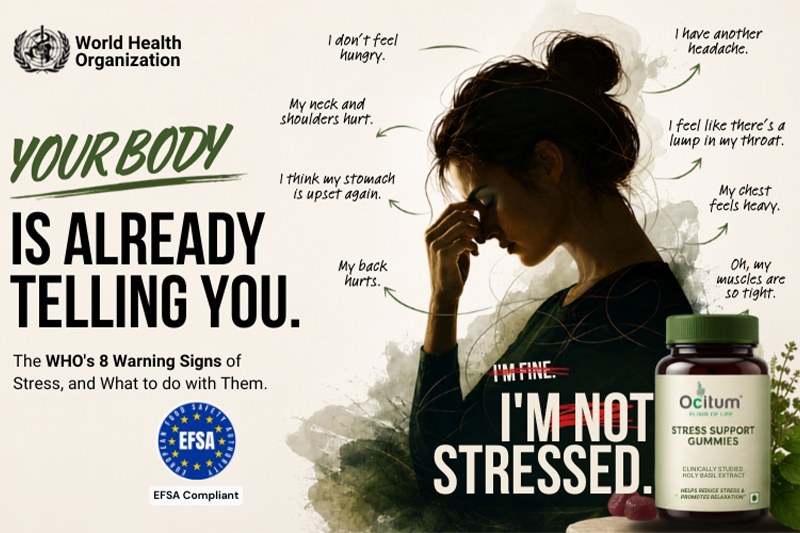
The World Health Organization has been trying to close that gap. Its stress-management guidance walks through the physical warning signs of stress leaves behind; the ones that are easy to dismiss individually and hard to ignore once you see them together. For an industry building products meant to help people manage exactly this, that list is worth sitting with.
The 8 signs the WHO points to
-
Headaches: often the first sign people notice, and the first they reach for a quick fix to solve.
-
Neck and shoulder pain: the body's habit of literally carrying tension in the upper back.
-
Back pain: stress doesn't stay in the mind; it settles into posture and muscle.
-
Muscle tension: a general tightness that can show up anywhere, not just the back and neck.
-
An upset stomach: the gut-brain connection means stress is felt in digestion long before it's named out loud.
-
Loss of appetite: or, just as often, the opposite. Either shift is worth noticing.
-
A feeling of heaviness in the chest: not always dramatic, but persistent enough to be uncomfortable.
-
A sensation of having a lump in the throat: one of the more overlooked signs, and one person rarely connects back to stress at all.
None of these symptoms are exclusive to stress on their own. A headache can be a headache. But when several of them cluster and persist, the WHO's broader guidance is clear: this is the body's way of asking for support, and it deserves to be taken seriously rather than pushed through.
Why this list matters for formulators, not just consumers
For the categories we work in, mind-mood, stress support, everyday resilience, this isn't just public health messaging. It's a map of where consumer demand is actually forming. European consumers aren't waiting for a diagnosis before they act. They're increasingly becoming proactive, reaching for daily, functional support the moment these signs become familiar, rather than after a health crisis forces the issue. That shift is a big part of why stress support has become one of the fastest-moving categories on the EU supplement shelf, and one of the most crowded.
It's also why heritage matters more than novelty right now. Buyers across the EU aren't looking for the newest stress ingredient to launch. They're looking for one with a track record long enough to trust, backed by the sourcing and documentation their regulatory teams expect as standard.
Where Ocitum™ fits
Ocitum™ is a standardized extract of Holy Basil (Tulsi), Ayurveda's "Elixir of Life" for over 3,000 years, now backed by the clinical data, what EU formulators expect. In a randomized, double-blind, placebo-controlled study (300 mg/day, 8 weeks, 60 subjects), Ocitum™ delivered:
- 35% reduction in cortisol, the stress hormone behind much of that WHO list, the tension, the gut upset, the tight chest
- 30% improvement in DASS-21 scores (the clinical scale for anxiety, stress and mood)
- 52.6% faster sleep latency, plus measurable gains in sleep efficiency and next-day alertness
Poor sleep and unmanaged stress feed each other, so addressing both at once makes for a stronger formulation story than mood alone.
A few other specifications the formulation teams tend to ask for: Standardized by USP for Total Ursolic Acid and synergistically working with Eugenol and Rosmarinic acid; 30-minute onset of action; non-habit forming with a clean NOAEL safety profile; full farm-to-extract traceability; and dosage formulation flexibility.
It's a heritage story with the trial data to back it, exactly the combination that the EU stress-support category is short on right now. If you're formulating this space and want the full technical dossier or a sample, we'd welcome the conversation.
www.phytoextractskp.com