
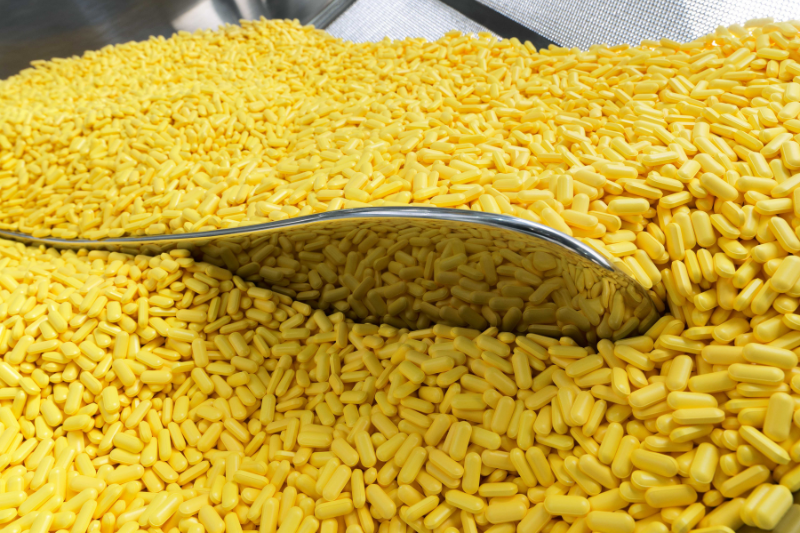
Managing film coating processes for hygroscopic and mechanically sensitive products represents a recurring challenge in solid oral dosage manufacturing. Customer expectations increasingly focus on robustness, process simplicity and predictable scale‑up from laboratory to full production. IMA Active’s Competence Center is designed to address these needs by combining application know‑how, scalable equipment design and structured experimental approaches.
This article describes a real case, managed together with company SYNCONA Germany, involving vitamin‑based, oblong tablets containing hygroscopic materials manufactured in the nutraceutical market.
The study demonstrates how two laboratory‑scale coating trials were successfully transferred to a pilot and then to a large production‑scale coater, highlighting how straightforward and reliable the coating and scale‑up activities can be when performed.
Dr. E. Lippacher GmbH & Co. KG (SYNCONA as the manufacturing brand), headquartered in Ismaning, Germany, is a long-established and family-run company with a rich history dating back to 1943. Now managed by Martin Lippacher in its third generation, the company has evolved significantly while maintaining its strong commitment to quality and innovation.
Originally dedicated to the production of pharmaceutical products under its own brands, the company was transformed around the year 2000. Since then, it has specialised exclusively in contract manufacturing services for the nutritional supplements industry, positioning itself as a reliable partner for customers seeking high-quality and tailor-made solutions.
Today, Dr. E. Lippacher GmbH & Co. KG offers a comprehensive range of core competencies covering the entire production process. These include formulation development from concept to finished product, granulation, tablet and capsule manufacturing, coating and final packaging. This integrated approach ensures efficiency, flexibility and consistently high standards throughout the value chain.
With a dedicated team of 27 employees, the company combines technical expertise with strong customer focus, delivering customised solutions that meet the evolving demands of the nutritional supplements market.
Product and process challenges
The product under evaluation consisted of oblong vitamin B tablets with a nominal core weight of approximately 1015 mg measuring 18.8 × 8 mm. The formulation combined hygroscopic ingredients with relatively low mechanical strength (75–105 N), creating a demanding coating scenario.
Such characteristics typically increase the risk of over‑wetting, sticking and mechanical damage. A robust yet simple coating process therefore needs to carefully balance spray rate, drying efficiency and tablet movement.
Laboratory‑scale film coating trials
Two laboratory‑scale trials were performed on a 30‑litre drum coater (PERFIMA LAB 30 L drum, IMA, Italy) using an HPMC‑based aqueous coating dispersion at 15.5% solids providing a viscosity of about 350 cps (AquaPolish® from Biogrund Germany).
The first trial followed conservative, customer‑aligned conditions and confirmed that the process could be managed smoothly with excellent coating quality.
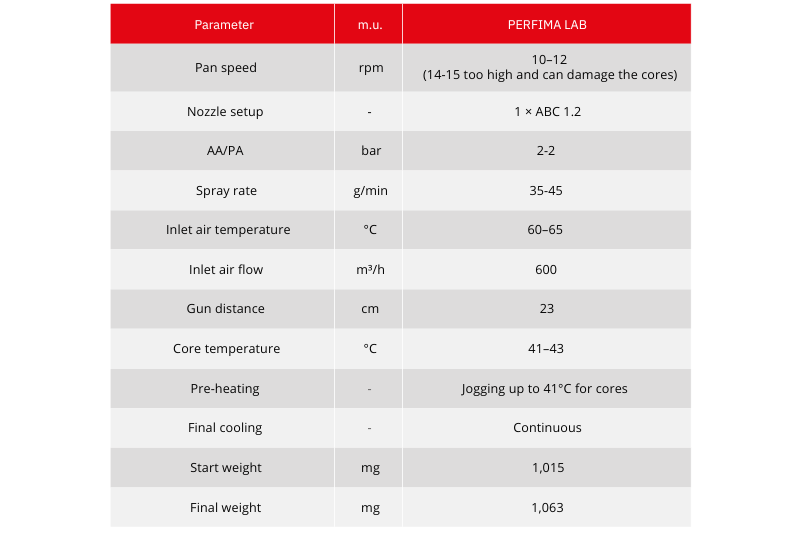
Table 1: Test 1 with PERFIMA LAB.
The second trial deliberately increased spray rate to define the upper operating limit, which was clearly identified without generating unexpected defects.
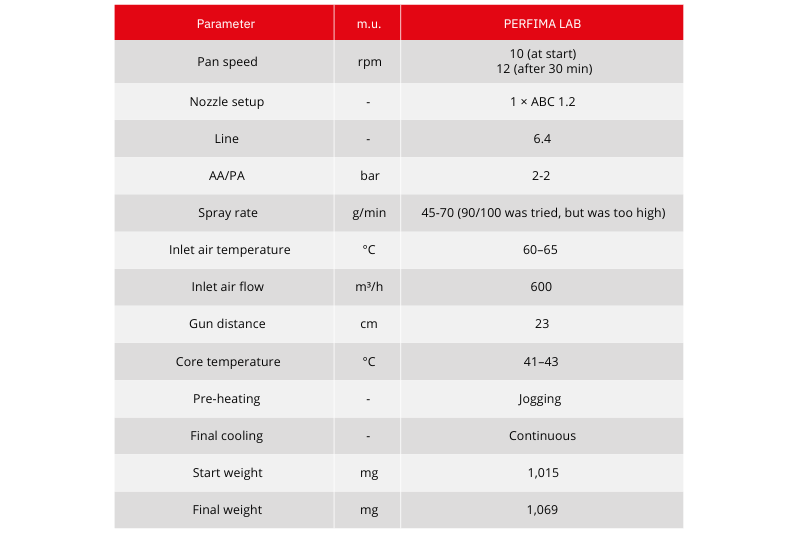
Table 2: Test 2 with PERFIMA LAB.
Laboratory trial outcomes and learning
The laboratory trials demonstrated stable process behaviour, uniform coating quality and limited material losses of approximately 8%. The equipment cleaning proved straightforward and operational recommendations were minimal.
Overall, the lab activity confirmed that coating of this hygroscopic vitamin product is both manageable and repeatable within a well‑defined process window.
Scale‑up to pilot and production
Based on laboratory data, the process was smoothly scaled up to a 150 kg pilot batch and further defined for 250 kg production scale. Thanks to consistent equipment geometry and mixing principles, parameter translation was linear and intuitive.
Both pilot and production configurations delivered predictable process behaviour, short coating times and high final product quality without the need for corrective interventions: this was a good basis for a further step to a 250 kg batch.
Key process parameters - coating and scale‑up
The consistency of the core process parameters across scales highlights the simplicity and predictability of the IMA Active coating scale‑up concept.
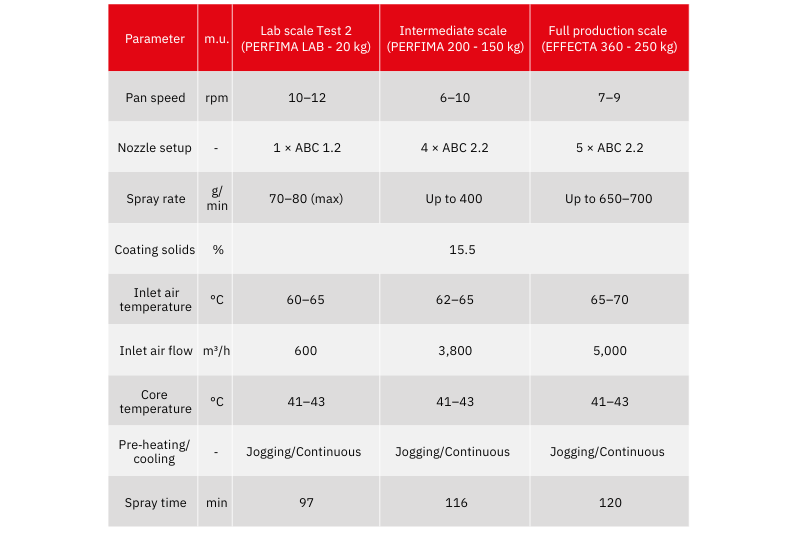
Table 3: key process parameters for all tests.
Conclusion
This case study demonstrates that film coating scale‑up for vitamin tablets can be achieved in a robust, predictable and reproducible manner when key process parameters are systematically defined and controlled. The applied approach, based on maintaining scalable critical process parameters (CPPs) - such as thermal load, air‑to‑product ratio and spray conditions- enabled the preservation of coating quality during the transition from pilot to commercial scale.
The results highlight that controlling thermal balance and drying dynamics is essential in order to ensure film uniformity, prevent surface defects and maintain final product stability, regardless of batch size. The adoption of scaling criteria based on physically meaningful parameters, rather than simple geometric scaling factors, significantly reduced the number of experimental trials required and accelerated technology transfer to production.
In conclusion, the methodology presented represents a reliable framework for film coating scale‑up in nutraceutical applications, with potential applicability to other sensitive formulations. This approach minimises the risk of quality deviations, optimises development timelines and costs, and supports consistent industrial manufacturing aligned with quality requirements.
![[EXCLUSIVE] White paper exploring accuracy, productivity and cleanliness in nutraceutical capsule filling](/exclusive-white-paper-exploring-accuracy-productivity-2-thumbnail.webp)


