
Probiotic products present a unique formulation challenge because they contain live microorganisms that must remain viable throughout manufacturing and shelf life to deliver their intended benefit. As discussed in Part One, stability can be heavily influenced by environmental conditions, excipient choice and packaging strategy. This case study shows how combining Nutracore® label friendly excipients with molecular sieve desiccants and controlled-atmosphere packaging improved the viability of Lactobacillus acidophilus under a range of storage conditions.
The stability challenge
Probiotics are highly sensitive to moisture and temperature. Exposure to humidity can increase water activity within the formulation, accelerating degradation and reducing the number of viable cells over time. For manufacturers, this creates a difficult balancing act: selecting excipients that support manufacturability and product performance while also helping to protect sensitive actives.
Many commonly used excipients do not actively contribute to moisture management. In this study, a conventional formulation based on microcrystalline cellulose (MCC) and magnesium stearate (Mg St) was compared with a formulation using Nutracore® Filler and Nutracore® Lubricant. The aim was to evaluate whether these label friendly excipients, used alongside different desiccant and packaging configurations, could better preserve probiotic viability.
Study design
The study evaluated a probiotic capsule formulation containing Lactobacillus acidophilus (200B CFU/g) using two excipient systems: one based on Nutracore Filler and Nutracore Lubricant, and a conventional comparator based on MCC and Mg St. These formulations were packed in multiple bottle configurations, including HDPE and Nutra active container system, with no desiccant, silica gel or molecular sieve desiccants at different loadings.
Samples were stored at 25°C/60% RH, 30°C/65% RH and 40°C/75% RH for three months.
Viability was measured after three months using AFU (Active Fluorescent Units), alongside water activity and loss on drying.
Nutracore-based formulations showed better probiotic survival
Across all storage conditions, the Nutracore-based formulation consistently maintained higher probiotic viability than the MCC-Mg St formulation. This difference became especially clear as storage conditions became more challenging.
At 25°C/60% RH, the Nutracore-based formulation delivered higher viability after three months across all packaging configurations than the MCC-Mg St comparator. The strongest results were seen in the Nutra active container system, where viability increased from 7900 to 8260 million cells/g, while the comparable MCC-Mg St system reached only 3610 million cells/g. Even in standard HDPE bottles with molecular sieve desiccants, the Nutracore formulation maintained substantially better viability than the conventional excipient system.
At 30°C/65% RH, the performance gap widened further. The MCC-Mg St formulation showed significant viability loss across every packaging setup, ranging from 598 to 3830 million cells/g after three months, while the Nutracore-based system retained markedly stronger survival, with results ranging from 2080 to 8520 million cells/g. Again, the Nutra active container system delivered the best protection, followed by smaller packs and higher molecular sieve loading.
The most striking results were seen under accelerated conditions at 40°C/75% RH. Under these harsher conditions, most packaging setups showed a drop in probiotic viability, particularly for the conventional MCC-Mg St system. However, the Nutracore-based formulation in the Nutra active container system retained 8350 million cells/g after three months, compared with 3940 million cells/g for the MCC-Mg St formulation in the same packaging configuration. These findings show that the right combination of excipient system and packaging can protect probiotic viability even under extreme storage stress.
Why moisture management matters
The results suggest that the improved performance of the Nutracore-based formulation is closely linked to its moisture-management properties. Compared with the MCC-Mg St formulation, the Nutracore system showed lower water activity at baseline and after storage, helping to create a more protective environment for moisture-sensitive probiotic cells.
Figure 1. LoD and water activity of Nutracore Filler compared to other filler excipients
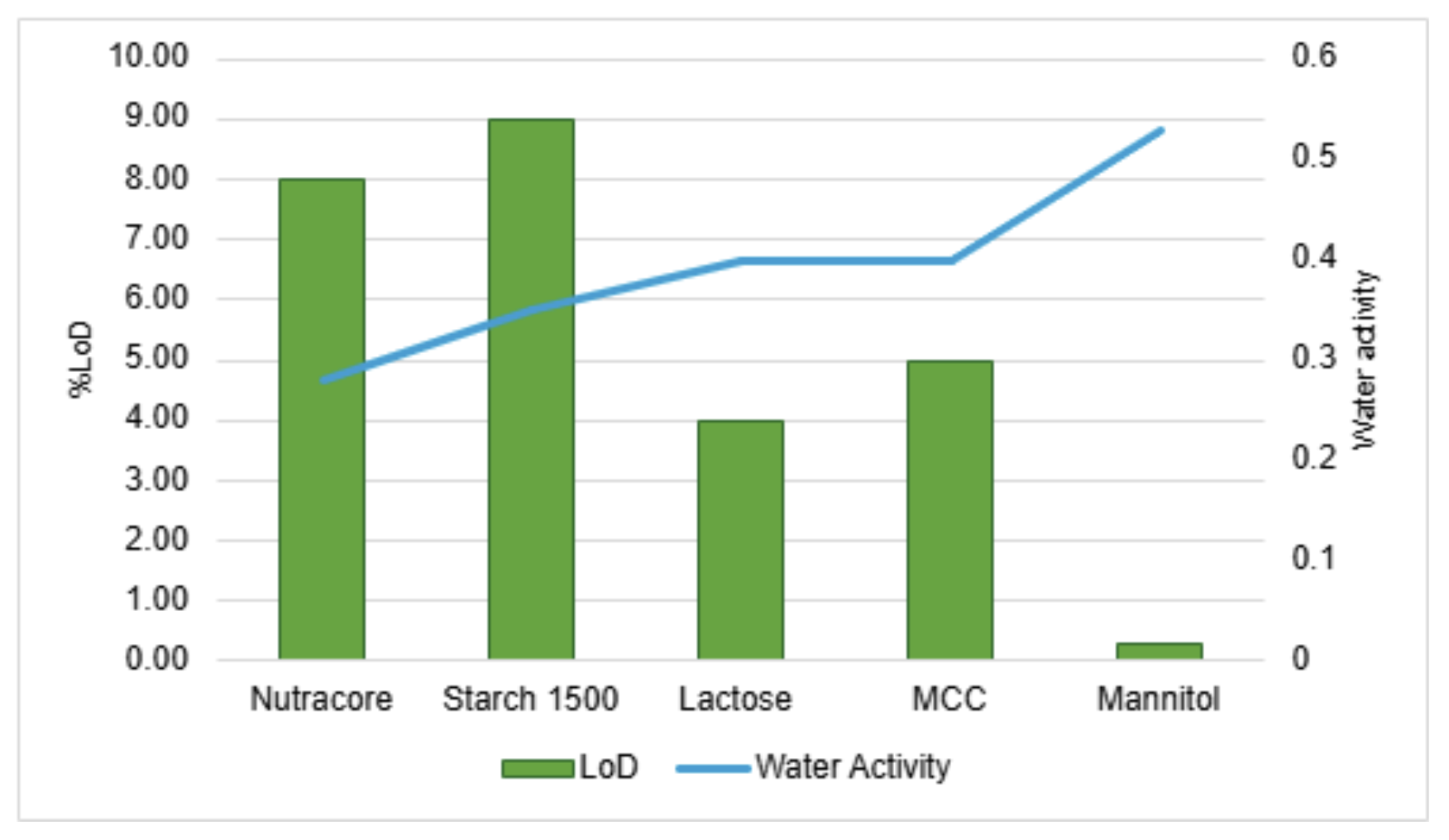
This distinction matters because water activity, rather than moisture content alone, is a critical factor in probiotic stability. The case study showed that the Nutracore formulation maintained significantly lower water activity than the MCC-Mg St comparator, despite differences in total moisture content, supporting better protection against moisture-induced degradation (figure 1).
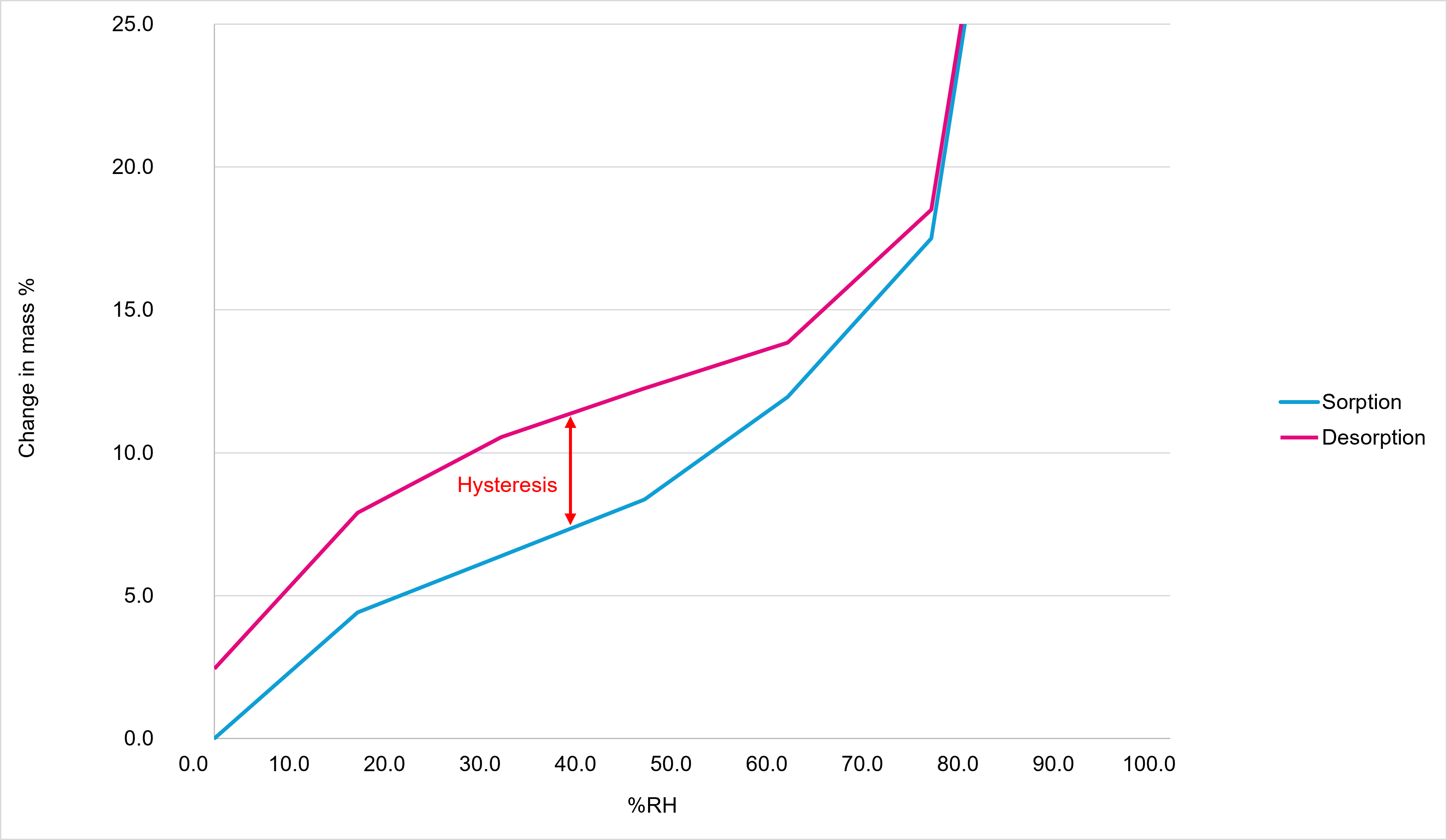
The study also showed that Nutracore Filler has moisture scavenging behaviour, as seen in its dynamic vapour sorption profile. It was able to absorb moisture and not fully release it during desorption, demonstrating hysteresis (figure 2). This suggests that it can help bind headspace moisture and reduce the likelihood of moisture interacting with the active ingredient.
Figure 2. DVS Isotherm of Nutracore Filler depicting hysteresis
Packaging and desiccants further improved outcomes
Although excipient choice had a major impact, packaging strategy also played a significant role. Across both formulation types, adding desiccant improved viability, and molecular sieve desiccants generally outperformed silica gel. Higher desiccant loading also delivered better protection in many cases.
The best overall results came from combining the Nutracore-based formulation with molecular sieve desiccants and an optimised container-closure system. Across both formulations, molecular sieve desiccants reduced water activity and loss on drying more effectively than no desiccant, while the Nutra active container system delivered the strongest moisture control overall.
This reinforces an important point for nutraceutical manufacturers: probiotic stability is rarely solved by formulation alone. It requires a system-level approach that considers the interaction between excipients, packaging materials, desiccant type, pack size and closure design.
Additional processing benefits
In addition to supporting stability, Nutracore Filler and Nutracore Lubricant also provided strong functional performance during processing. The study reported excellent flow, compressibility and lubrication, indicating that these excipients can support both manufacturing efficiency and product protection.
This is a valuable advantage for formulators looking to simplify development. Rather than choosing between processability and stability support, the right excipient system may help deliver both.
Closing thoughts
This case study shows that formulation and packaging decisions can have a major impact on probiotic viability and shelf life. Compared with a conventional MCC-Mg St formulation, the Nutracore-based system maintained higher viability, lower water activity and stronger overall protection throughout the three-month study, particularly when paired with molecular sieve desiccants and effective moisture-control packaging.
For nutraceutical manufacturers, the findings highlight the value of a more integrated approach to stability. Selecting excipients that actively support moisture management and pairing them with appropriate packaging can help manufacturers meet label claims more confidently, reduce the need for overages, support longer shelf life under real-world conditions, and improve product robustness across different markets and climates.
For the full study, contact Colorcon at www.colorcon.com.


