
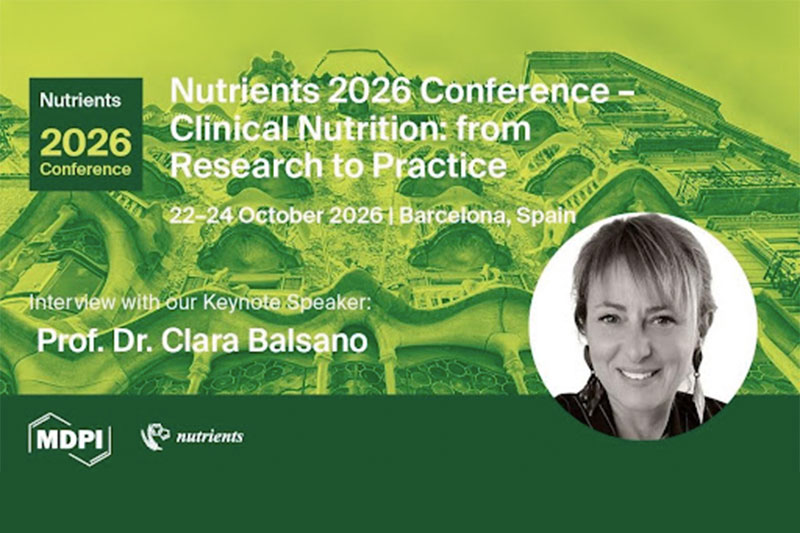
In the following interview, she introduced us to her current research and findings, and shared with us how she overcame the difficulties she faced in her research, as well as her views on the emerging trends in the next few years. Prof. Dr. Balsano also recommended key publications and systematic reviews addressing the role of artificial intelligence in healthcare, which conference attendees can read beforehand.
1. Self-Introduction
My name is Clara Balsano. I am a full professor of Internal Medicine at the University of L’Aquila, Italy, and I currently serve as the Head of the Complex Unit of Geriatrics at SS. Filippo e Nicola Hospital in Avezzano. In addition to my clinical responsibilities, I direct research laboratories focused on molecular biology and intelligent systems applied to the diagnosis and treatment of chronic inflammatory diseases. I am also the President of the Francesco Balsano Foundation and am actively involved in initiatives related to artificial intelligence in medicine.
2. Research Background and Current Focus
What first sparked your interest in this field, and who or what has been most influential in shaping your research journey?
My interest in this field originated during my medical training and was significantly shaped by my early research experiences in international laboratories, particularly in France and the United States. These environments fostered the strong integration of basic science and clinical research, which has remained a defining feature of my scientific career.
Could you describe your current research focus and share any recent developments or key findings with us?
My research focuses on the study of chronic liver diseases, particularly metabolic-associated fatty liver disease (MAFLD/NAFLD), exploring its molecular basis, epigenetic regulation, and progression toward more severe conditions such as cirrhosis and hepatocellular carcinoma.
More recently, my research has concentrated on the integration of multi-omics data and the application of artificial intelligence and machine learning approaches to identify novel biomarkers and therapeutic targets. This includes the use of advanced computational models to analyse complex, non-linear biological systems and to improve early diagnosis and patient stratification.
What major challenges have you encountered in your research, and how have you addressed them?
One of the major challenges in my research has been the effective integration of heterogeneous datasets, including clinical, molecular, and imaging data. To address this, I have promoted a multidisciplinary approach, combining expertise from medicine, biology, and data science. Another challenge has been translating experimental findings into clinical practice; this has been tackled through a translational research framework and participation in multicenter studies.
3. Keynote Talk
What is the title of your keynote lecture at Nutrients 2026, and which conference session does it align with?
My keynote lecture at Nutrients 2026—Clinical Nutrition: from Research to Practice is entitled, “Application of Artificial Intelligence in Medicine: Opportunities and Challenges”, which falls into Session 5: The potential role of AI in clinical practice, focusing on the integration of advanced computational tools into modern healthcare.
Could you briefly outline the main themes of your talk and explain why this topic is particularly relevant today?
The lecture will explore several interrelated themes at the intersection of artificial intelligence and clinical practice:
First, I will address the evolution of AI methodologies, particularly machine learning and deep learning approaches, in the analysis of complex biomedical datasets. These tools are transforming our ability to identify patterns that are not detectable through traditional statistical methods.
Second, the talk will focus on personalised nutrition, emphasising how AI can integrate genomic, metabolomic, microbiota, and lifestyle data to develop individualised dietary interventions. This represents a paradigm shift from generalised dietary recommendations to precision-based approaches tailored to the individual patient.
Third, I will discuss the clinical application of predictive models, including risk stratification for chronic diseases such as metabolic syndrome, non-alcoholic fatty liver disease, and cardiovascular disorders. AI-driven tools can support clinicians in early diagnosis, prognosis estimation, and therapeutic decision making.
Another key aspect will be the integration of AI into clinical workflows, highlighting both opportunities and challenges. These include issues related to data quality, the interpretability of algorithms, ethical considerations, and the necessity of maintaining a patient-centered approach in technologically advanced environments.
Are there any key publications or resources you would recommend for attendees who wish to prepare for your talk?
Several key publications underpin the concepts presented in this lecture. These include the following:
- Foundational studies on machine learning applications in clinical nutrition and metabolic diseases, which demonstrate the predictive power of AI models in identifying disease risk and treatment response;
- Recent systematic reviews addressing the role of artificial intelligence in healthcare, with particular attention to clinical decision support systems and digital health platforms.
Some of the most important are listed below:
- “Driving AI Health Innovation through the European Health Data Space: Opportunities and Challenges for Non-EU Country Participation”. Cervera de la Cruz P., Hazel J.W., J.D., Shabani M., Glenn Cohen I., J.D. NEJM, 2026;
- “AI-Enabled Precision-Education Systems — Transforming Lifelong Learning in Medicine”. Desai S.V.,, Khan S., and Lomis K. NEJM, 2026;
- “Measuring the Return on Investment for Clinician-Facing Artificial Intelligence Technologies”. Rotenstein L.S., Wachter R.M., Bates D.W. JAMA, 2026;
- “As of my last knowledge update: How is content generated by ChatGPT infiltrating scientific papers published in premier journals?” Strzelecki A., Learned Publishing, 2024.
- “Academics as adopters of generative AI: an application of diffusion of innovations theory”. Strzelecki A., Education and Information Technologies, 2026.
The integration of nutritional science with advanced computational tools represents a promising frontier in modern medicine; therefore, the proposed meeting is expected to play a crucial role in updating participants on emerging developments and fostering informed discussion.
4. Nutrients 2026
In your view, what distinguishes Nutrients 2026 from other conferences in the field?
In my view, Nutrients 2026 stands out among international conferences due to its strong interdisciplinary focus, bringing together experts in clinical nutrition, molecular biology, and translational medicine. This integrated perspective is essential for addressing complex health challenges.
As a keynote speaker, what do you hope this conference will offer to scholars and researchers worldwide?
As a keynote speaker, I hope that this conference will foster meaningful scientific exchange, encourage collaboration across disciplines, and provide a platform for discussing innovative approaches to patient care and research.
From your perspective, what are the main benefits of participating in this conference?
Participation in this conference offers several benefits, including exposure to cutting-edge research, opportunities for networking with leading scientists, and the possibility of establishing new collaborative projects. It also allows young researchers to engage with experienced investigators and gain valuable insights into emerging trends.
5. Open Access Publishing
What are your views on recent trends and developments in open-access publishing, particularly in the field of nutrition research?
Open-access publishing has significantly transformed the dissemination of scientific knowledge. In the field of nutrition research, it has facilitated rapid and widespread access to data, promoting transparency and accelerating scientific progress.
However, it is essential to maintain high standards of peer review and scientific rigor. While open access increases visibility and accessibility, it also requires careful regulation to ensure quality and to avoid the proliferation of low-impact or non-validated studies.
Overall, I believe that open-access publishing represents a valuable opportunity for the scientific community provided that quality control mechanisms remain robust.
6. Emerging Trends and Key Discussion Topics
What do you see as the most important emerging or “hot” topics in clinical nutrition over the next few years, and why?
In the coming years, I believe that several key areas will emerge as particularly important in clinical nutrition and hepatology. Among these, the role of the gut microbiota in metabolic regulation and disease progression will be central.
Another critical topic is the application of artificial intelligence in clinical practice, particularly for early diagnosis, risk prediction, and personalised treatment strategies. The integration of multi-omics data, including genomics, metabolomics, and microbiomics, will further enhance our understanding of disease mechanisms.
Additionally, there will be increasing attention to gender differences in metabolic diseases, as well as to the identification of novel therapeutic approaches, including the use of natural compounds and bioactive molecules.
These emerging trends reflect a shift toward precision medicine, where treatment strategies are tailored to the individual patient based on complex biological and environmental factors.
Nutrients 2026: Abstract Submission and Early Bird Registration
For those interested in joining Prof. Dr. Clara Balsano and other leading experts in clinical nutrition and healthcare research at Nutrients 2026—Clinical Nutrition: From Research to Practice, please visit the links below for more information and registration details.
Submit your abstract and present your research at Nutrients 2026: https://sciforum.net/user/submission/create/1496.
Register now for Early Bird prices: https://sciforum.net/event/Nutrients2026?section=#registration.
The Nutrients 2026 organising committee actively encourages partnerships with professional societies, clinical nutrition organisations, food industry companies, and research institutions.
The conference creates an ideal environment for forging connections with leading researchers, healthcare professionals, and policymakers who are actively shaping the future of clinical nutrition. Industry representatives will find valuable opportunities to explore research initiatives and learn about emerging market trends in clinical nutrition.
For more details, please visit Nutrients 2026 official website, https://sciforum.net/event/Nutrients2026, or contact us at nutrients2026@mdpi.com.


