

For most supplement manufacturers, personalisation and scale sit at opposite ends of a trade-off. The more bespoke the product, the harder and costlier it is to produce in volume.
UK-based Rem3dy Health — the company behind 3D-printed vitamin gummy brand Nourished — has spent the best part of a decade trying to eliminate that trade-off. And now that endeavour seems to be coming into fruition.
 The firm closed a £14m funding round in June of this year, backed by a group of investors including Japanese beverage giant Suntory, Spanish brewer Estrella Galicia, Indian hospital operator Apollo Hospitals and French pharma company UPSA, valuing the business at £84m.
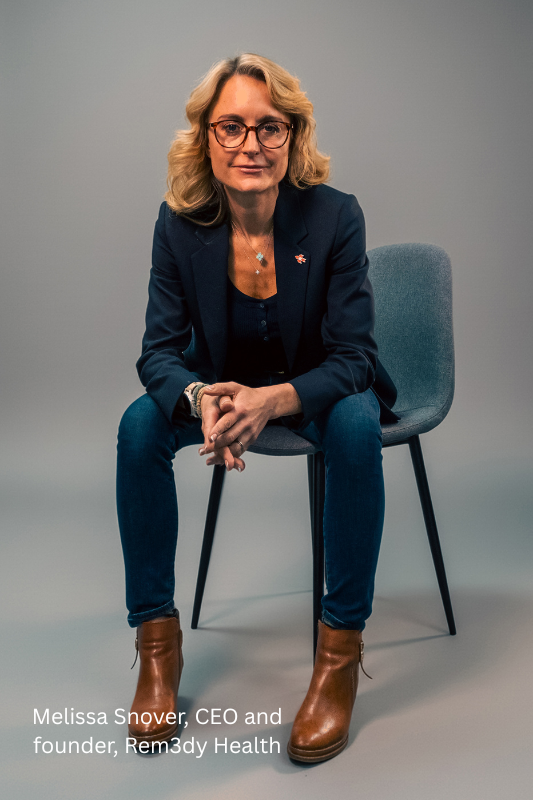
Emily Letton from Nutraceutical Business Review spoke to founder and CEO Melissa Snover about the manufacturing challenges behind building a personalised nutrition brand that has now sold more than 53 million units and produces gummies from what the company says are more than ten million possible formulation combinations.
Creating the platform before the product
Snover says that the technology didn't exist when she started. "When I first began exploring additive manufacturing for personalised consumer health products in 2015, it quickly became apparent that traditional production systems were fundamentally designed for mass manufacture. Our ambition was to create products tailored to the individual," she says.
In many respects, we had to invent the manufacturing platform before we could create the product category.
That meant simultaneously solving problems in formulation, dosing, process control and quality assurance, drawing on "material science, software engineering, robotics, food technology and nutritional science."
The result is a system Snover describes as enabling "the precise codelivery of multiple active ingredients within a single product while maintaining the consistency, traceability and manufacturing efficiency expected of modern commercial production."
Mass personalisation
Instead of treating customisation as a manufacturing exception, Snover says Rem3dy built personalisation into the architecture of production itself, combining AI, software and additive manufacturing.
"The result is what we describe as mass personalisation," she explains. "Every product can be tailored to an individual's unique needs while still benefiting from the rigorous quality controls, traceability and operational efficiencies required for commercial-scale manufacturing."
Recent investment in automation, she adds, has "significantly increased throughput while maintaining the flexibility needed to produce highly customised products.” This investment has meant the company can create up to 500,000 personalised doses a day at its Birmingham, UK, facility.
Protecting sensitive actives
Ingredient stability is a common problem for nutraceutical formulators. "Many bioactive compounds are sensitive not only to heat, but also to acidity levels, oxidation, moisture and interactions with other active ingredients," Snover says.
 To address this, Rem3dy's process runs at lower temperatures than many conventional methods, but temperature control, Snover says, "is only one part of the solution.” Formulation design, ingredient selection and process parameters are all tailored to the stability profile of each compound, backed by internal and third-party stability testing throughout a product's shelf life.
The company has also developed proprietary vegan encapsulation technologies that physically separate active ingredients within individual layers of a singular gummy. "This serves to eliminate undesirable interactions between ingredients while enabling the codelivery of multiple actives that would traditionally be challenging to formulate together," Snover says.
That layer-by-layer control, she claims, means Rem3dy can "precisely control the placement, quantity and separation of individual active ingredients within a single product," optimising stability and taste while minimising unwanted interactions between actives.
Rather than creating one product for millions of consumers, we can create millions of product variations while maintaining manufacturing consistency and quality.
Quality control across different products
Consistency in the manufacturing process is arguably the harder problem once personalisation is added into the mix. Snover points to "ingredient compatibility, formulation stability, precision dosing, automation and traceability" as the core technical hurdles Rem3dy has had to solve during the past decade.
She adds that it has required expertise spanning "material science, software engineering, robotics, food technology and nutritional science."
The resulting platform is now protected by 29 patents. "Personalised nutrition places even greater demands on manufacturing and quality systems than traditional mass production," she says.
Every product must be accurately formulated, fully traceable and produced to the same rigorous standards regardless of its individual composition.
A regulatory landscape still catching up
Additive manufacturing in nutraceuticals (and pharmaceuticals) continues to face real challenges, including regulatory ambiguity, high equipment costs and a small range of printable materials.1 Snover says that Rem3dy has treated compliance as a design principle rather than an afterthought, building its systems within existing FDA and FSA frameworks.
"Innovation often advances faster than regulation, but we view this as an opportunity for constructive collaboration rather than a challenge," she says.
With the new funding that was raised this year earmarked for expansion into the US, India and the Middle East (markets in which the regulatory scrutiny of health claims can be tighter than in the UK), that collaborative approach is about to be tested beyond Rem3dy's home market.


