“This clinical trial indicates that supporting the innate immune system with yeast beta-glucan before and after vaccination can translate into stronger vaccine-specific antibody responses, an encouraging signal for both immune health and healthy aging,” said Philippe Caillat, Category Manager at Lallemand Bio-Ingredients. “This data from the group of Dr. Wendy Dahl at University of Florida suggest a meaningful bridge between innate immune priming and adaptive antibody production.”
Why a Flu Shot Model Matters: Connecting Innate Training to Adaptive Antibody Responses
Researchers increasingly use seasonal influenza vaccination as a controlled, real-world immune challenge to probe how well an intervention modulates vaccine immunogenicity, particularly in older adults, where responses can be blunted. A rise in HAI titers after vaccination is an accepted serological marker of vaccine responsiveness and a practical readout of adaptive immunity. [cdc.gov], [academic.oup.com]
M-Gard is a purified yeast beta-glucan characterised by beta-1,3 backbones with beta-1,6 branches, known to engage pattern recognition receptors such as Dectin-1 on innate immune cells. By priming innate cells through receptor-mediated signaling, beta-glucans are hypothesised to promote trained immunity, a memory-like state in innate cells, thereby improving the quality of subsequent responses to heterologous challenges, including vaccines.
In the context of a flu shot model, a more pronounced HAI antibody increase after priming aligns with the concept that a better prepared innate compartment can shape more effective adaptive responses. [bio-lallemand.com], [connect.bi...lemand.com]
“We deliberately chose influenza vaccination as a standardised challenge to evaluate immune fitness,” says Melissa Moreno, PhD candidate in Nutritional Sciences at the University of Florida and first author of the study. “Antibody titers give us a clinically interpretable signal. Seeing a greater post-vaccine rise after yeast beta-glucan supports the notion that training innate immunity can set the stage for a more robust adaptive response.” [tandfonline.com]
Study at-a-Glance
- Design: Double-blind, randomised, placebo-controlled pilot trial. [tandfonline.com]
- Participants: Adults ≥50 years (mean ~71 years). [tandfonline.com]
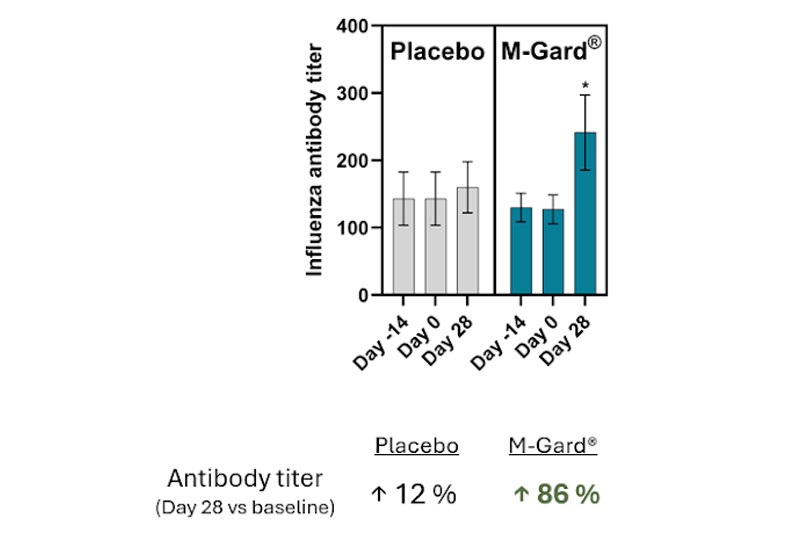
- Intervention: M-Gard 500 mg/day (or placebo) for 6 weeks; vaccination at week 2. [tandfonline.com]
- Primary Readout: HAI antibody titers 4 weeks post-vaccination. [tandfonline.com]vaccination.
- Key Signal: Antibody titer increased by 86 % in the M-Gard group vs only 12 % in those taking placebo (p = 0.037), supporting a significant adjuvant-like effect. [tandfonline.com]
Consistency With Preclinical Research
The human findings align with a cumulative body of preclinical and veterinary evidence showing beta-glucans can enhance vaccine responses:
- Oral beta-glucan were shown to modulate humoral responses, influencing antigen- specific Ig isotypes around routine vaccination in healthy dogs. Although isotype shifts (e.g., transient changes in IgA/IgM) require careful interpretation, the data indicate that oral yeast beta-glucan can modulate vaccine-related antibody kinetics. [journals.asm.org], [biblio.ugent.be]
- Additional veterinary studies report that beta-glucan exposure can accelerate the rise in antibody titers and enhance elements of innate function (e.g., phagocytic activity, reduction in inflammation marker TNF-α), consistent with a trained immunity-based adjuvant concept. [Researchgate], [Pubmed]
Together, these findings support a mechanistic narrative in which yeast beta-glucans prime innate sentinels (monocytes/macrophages, dendritic cells), improving antigen presentation and cytokine cues that ultimately shape B and T-cell responses, yielding stronger or faster antibody rises following vaccination, which here mimics a potential infectious challenge. [bio- lallemand.com]
Philippe Caillat
Category Manager
Annie Tremblay, PhD
Scientific Affairs Manager